
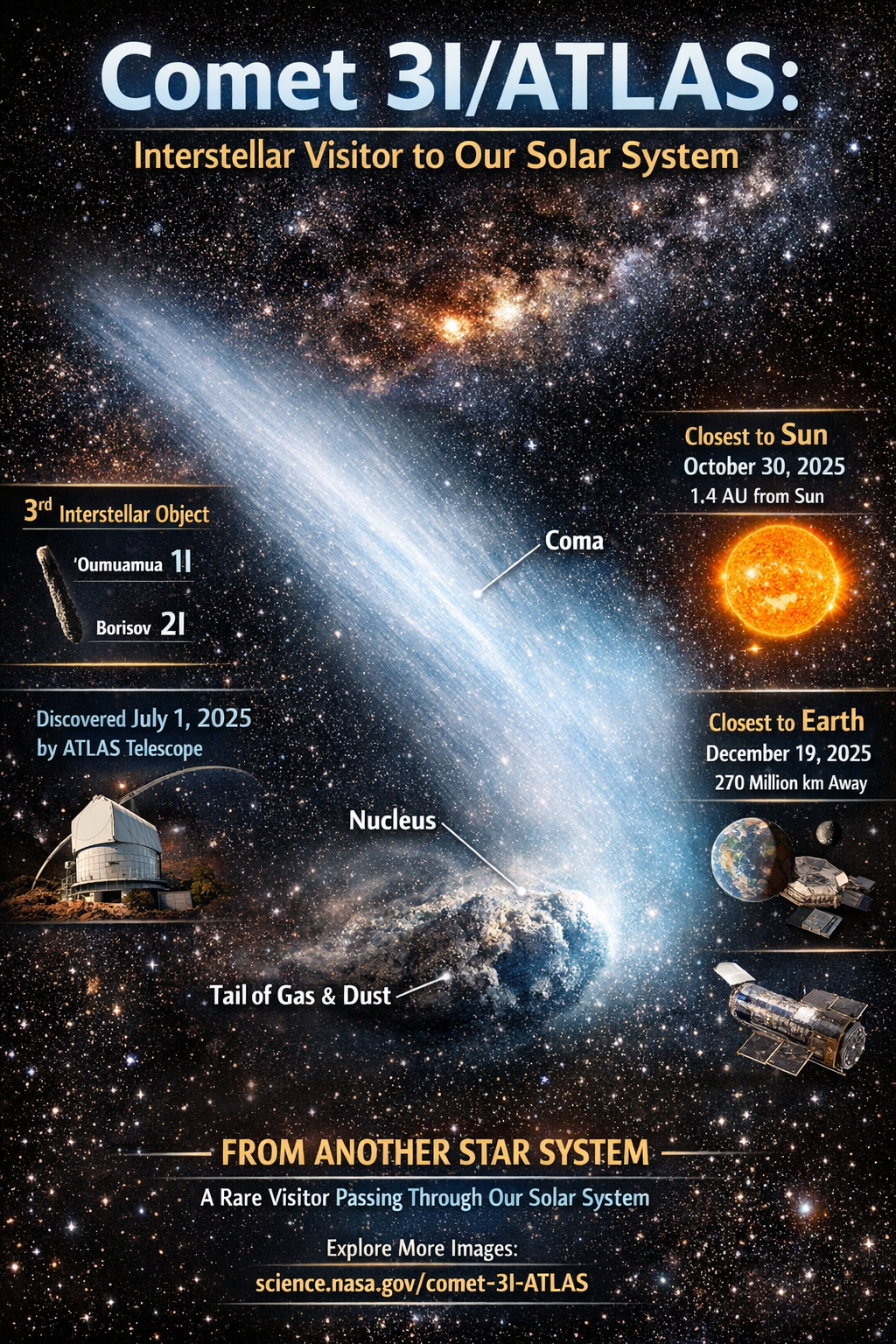
Comet 3I/ATLAS is a very special visitor to our Solar System.
It is only the third known object ever discovered that came from outside our Solar System.
Scientists call such objects interstellar objects.
This means they were formed around another star, not our Sun.
Before 3I/ATLAS, only two such visitors were confirmed:
- ‘Oumuamua (1I) in 2017
- Borisov (2I) in 2019
So 3I/ATLAS is officially named the third interstellar object, which is why it has the label “3I”.
How Was It Discovered?
3I/ATLAS was discovered on 1 July 2025.
It was spotted by the ATLAS telescope in Chile.
ATLAS stands for Asteroid Terrestrial-impact Last Alert System.
It is a NASA-funded telescope system that scans the sky to detect asteroids and comets early.
Scientists quickly realized this object was not from our Solar System.
Its speed and path showed it was just passing through — a one-time visit.
Why Is It Called a Comet?
3I/ATLAS is an active comet.
What does “active” mean?
As the comet gets closer to the Sun, heat causes its ice to release gas and dust.
This process is called outgassing.
Because of outgassing, the comet forms:
- a coma – a glowing cloud of gas and dust around the comet’s core
- a tail – a long stream of material pushed away by sunlight and solar wind
These features make comets easier to study than rocky objects.
Closest Point to the Sun (Perihelion)
3I/ATLAS reached its closest point to the Sun around 30 October 2025.
This closest point is called perihelion.
At perihelion, the comet was about 1.4 astronomical units (AU) from the Sun.
What is an Astronomical Unit (AU)?
1 AU = the average distance between Earth and the Sun
That is about 150 million km
So 1.4 AU means the comet was farther than Earth’s orbit, around 210 million km from the Sun.
Closest Approach to Earth (December 2025)
The comet came closest to Earth on 19 December 2025.
It passed at a distance of about:
- 170–180 million miles
- 270–290 million kilometers
- about 1.8–1.9 AU
This is very far away.
There was no danger to Earth.
Because of the distance, the comet cannot be seen with the naked eye.
Only telescopes can observe it.
Who Is Observing Comet 3I/ATLAS?
Many space agencies are watching this rare visitor.
NASA’s Hubble Space Telescope
Hubble has taken high-resolution images of the comet.
These images show details of its coma and tail.
They help scientists understand its structure and activity.
NASA’s Psyche and Lucy Spacecraft
These spacecraft are traveling to study asteroids.
While on their journey, they captured images of 3I/ATLAS from tens of millions of miles away.
This helps scientists calculate the comet’s exact path (orbit).
Orbit means the path an object follows through space.
ESA’s JUICE Mission
JUICE stands for Jupiter Icy Moons Explorer.
It is a European Space Agency spacecraft.
JUICE observed the comet in November 2025 from a very long distance.
The data is still traveling back to Earth and is expected in early 2026.
Can Ordinary People See It?
Yes — with help.
Amateur astronomers and observatories are tracking the comet.
Projects like the Virtual Telescope Project provide live online views.
The comet is best seen before sunrise (pre-dawn).
It should remain observable with telescopes into early 2026.
Want to See Real Images of Comet 3I/ATLAS?
NASA has released official images of the comet taken by powerful telescopes.
Check them here:
https://science.nasa.gov/solar-system/comets/3i-atlas/comet-3i-atlas-image-gallery/
Why Is 3I/ATLAS Important?
Comet 3I/ATLAS is like a message from another star system.
It carries material formed far outside our Solar System.
By studying it, scientists can:
- Learn how other star systems form
- Compare alien material with our own comets
- Better understand the building blocks of planets
Such visitors are rare.
Each one gives us a unique chance to study the universe beyond our neighborhood.
Leave a Reply