
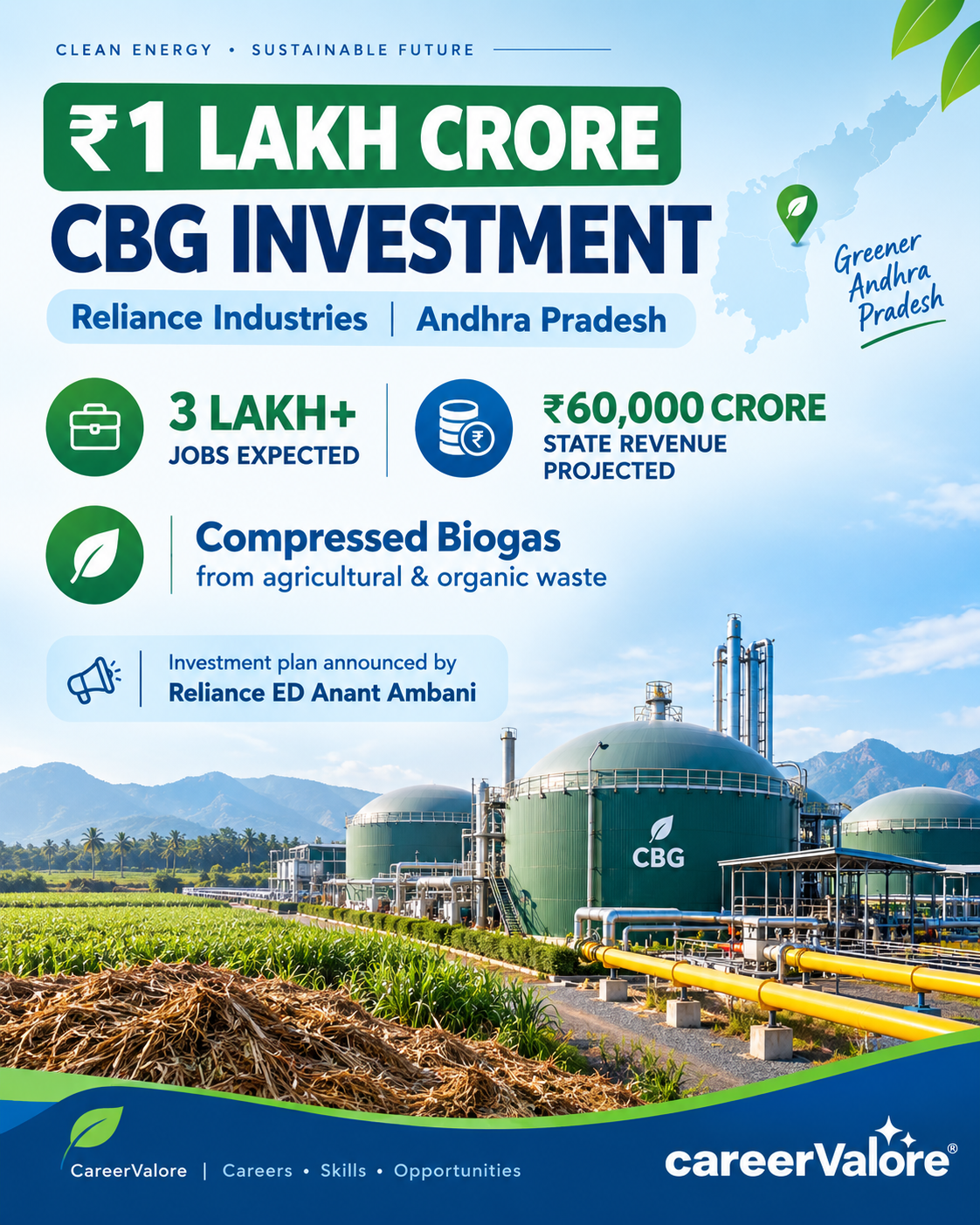
Reliance Announces Major Clean-Energy Investment in Andhra Pradesh
Andhra Pradesh could see a major expansion in its clean-energy and rural economy as Reliance Industries plans to invest ₹1 lakh crore in the state to establish compressed biogas (CBG) projects.
The announcement was made by Reliance Industries Executive Director Anant Ambani during the foundation stone-laying ceremony for the Rayalaseema Horticulture Hub and Indian School of Agriculture at Madanapalle on October 2, 2026.
According to the announcement, the proposed CBG projects are expected to create more than 3 lakh jobs and generate nearly ₹60,000 crore in revenue for Andhra Pradesh over the coming decades. (The Economic Times)
What Is CBG?
Compressed Biogas (CBG) is a renewable fuel produced by processing organic materials such as:
- Agricultural residue
- Animal dung
- Food and organic waste
- Other biomass
The organic material is processed to produce methane-rich biogas, which can then be purified and compressed for use as fuel.
This makes CBG interesting for both the energy sector and agriculture, because agricultural waste can become a useful source of energy instead of simply being discarded.
Key Numbers at a Glance
| Particular | Details |
|---|---|
| Company | Reliance Industries |
| Proposed investment | ₹1 lakh crore |
| Project | Compressed Biogas plants |
| Location | Andhra Pradesh |
| Jobs expected | 3 lakh+ |
| Projected state revenue | Nearly ₹60,000 crore |
| Focus areas | Clean energy, agriculture and rural economy |
These figures are based on the investment plan announced by Reliance’s Executive Director Anant Ambani. (The Economic Times)
Why Is This Important for Andhra Pradesh?
The project connects three areas that are increasingly important for the state’s development: agriculture, energy and employment.
1. New opportunities in clean energy
Large CBG projects can create demand for workers involved in plant operations, maintenance, engineering, quality, logistics, safety and other technical functions.
2. Agricultural waste can become an economic resource
CBG plants can use agricultural and organic waste as feedstock. This can potentially create additional economic opportunities around the collection, transportation and supply of biomass.
3. Rural employment
Because CBG projects can be located closer to agricultural and biomass sources, employment opportunities may extend beyond major cities.
4. New business opportunities
A large CBG ecosystem can also create opportunities for supporting businesses in:
- Biomass collection
- Transportation and logistics
- Equipment maintenance
- Plant operations
- Waste management
- Quality testing
- Engineering services
What Does This Mean for Students and Job Seekers?
The important point is that 3 lakh+ jobs is an expected employment figure for the overall projects, not 3 lakh vacancies available today.
As the projects move forward, opportunities could emerge across multiple skill areas.
Students and early professionals interested in this sector can start building skills in:
Engineering: Mechanical, Electrical, Chemical and related fields
Operations: Plant operations, maintenance and production
Data & Technology: Excel, SQL, Power BI, Python and industrial data analysis
Business Functions: Procurement, supply chain, project coordination and documentation
Safety & Quality: EHS, quality control and compliance
This is particularly relevant for people looking for opportunities outside traditional IT jobs.
Andhra Pradesh Already Has a CBG Project Pipeline
This announcement also builds on Reliance’s earlier CBG plans in Andhra Pradesh.
In April 2025, Reliance announced that it had broken ground on its first CBG plant in Kanigiri, Prakasam district, as part of a planned series of 500 projects involving ₹65,000 crore in investment at that time. The first project was announced with a capital investment of ₹139 crore. (Reliance Industries Limited)
The newer ₹1 lakh crore announcement therefore represents a significant expansion of the clean-energy investment plan.
What Should Job Seekers Do Now?
Don’t wait for specific vacancies to appear before preparing.
If you are interested in clean energy, manufacturing or rural infrastructure, start developing a combination of technical and business skills.
For example:
Mechanical/Engineering graduate → Plant operations + maintenance + Excel
Data/Analytics candidate → Excel + SQL + Power BI + industrial data
Business/Operations candidate → Procurement + supply chain + project coordination
Fresh graduate → Communication + Excel + domain knowledge + internship/project experience
The strongest candidates will not only understand their technical subject but also understand how an industrial project operates.
One Important Point
This is an investment plan and employment projection, not a current recruitment announcement.
The reported 3 lakh+ figure represents employment expected from the proposed projects. Job seekers should wait for official recruitment announcements from Reliance or its project partners before treating the number as available vacancies.
Final Takeaway
Reliance Industries’ proposed ₹1 lakh crore CBG investment could become an important development for Andhra Pradesh’s clean-energy and rural economy.
With 3 lakh+ jobs expected and nearly ₹60,000 crore in projected state revenue over the coming decades, the initiative could create opportunities across energy, agriculture, manufacturing, logistics, engineering and business operations. (The Economic Times)
For students and professionals, the bigger lesson is simple: new industries create new skill requirements. Preparing early can help you take advantage of those opportunities when they become available.
Stay Connected with CareerValore
Blogs, quizzes & career updates:
CareerValore WhatsApp Channel
Job Updates & Career Alerts:
CareerValore Telegram Channel
Daily Job Updates:
CareerValore WhatsApp Job Updates
Source note: The ₹1 lakh crore investment, 3 lakh+ jobs and ₹60,000 crore projected revenue figures have been independently reported by PTI and multiple business publications. Reliance’s earlier CBG project in Kanigiri provides additional background. (The Economic Times)