
The AI Productivity Paradox: Why You’re More Exhausted Than Ever (and How to Fix It)
It’s 2026. We were promised that by now, AI would be doing the heavy lifting while we sipped espresso and “strategized.” Instead, most of us feel like underpaid babysitters for a collection of very brilliant, very erratic robots.
If you find yourself ending the workday with a pounding headache despite using GPT-5, Claude 4, or your favorite agentic suite for everything, you aren’t experiencing a lack of features. You’re experiencing the AI Productivity Paradox.
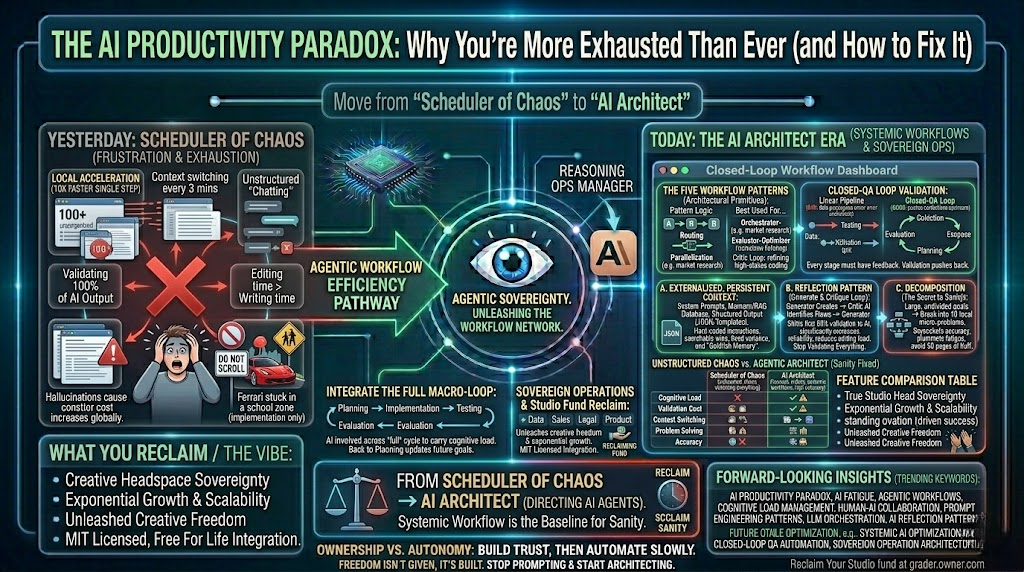
The hard truth? AI accelerates tasks locally but increases your cognitive cost globally. You are no longer a “creator”—you have become a Scheduler of Chaos.
1. The Trap of Local Acceleration
The paradox is simple: AI makes a single step (like writing an email or coding a function) 10x faster. However, because that step is now “free,” we do it 20 times instead of once. We iterate more than necessary, switch contexts every three minutes, and spend our entire day validating AI output rather than solving the actual problem.
We are working on the AI instead of on the goal. To fix this, we have to move away from unstructured “chatting” and toward systemic workflows.
2. Closing the Loop: The End of Linear Pipelines
In a classic data pipeline, you collect, curate, train, and evaluate. It looks like a straight line. The problem? Linear models ignore systemic errors. If your data is bad at the start, that error propagates forward, unchecked, until it hits the human at the end of the line.
The Solution: You must close the QA loop.
Every stage of your work—whether it’s data curation or writing a marketing plan—must have a feedback mechanism that pushes corrections upstream. If the “Evaluation” phase finds a flaw, it shouldn’t just be fixed locally; the “Collection” phase needs to be updated. Validation must have the power to push back.
3. The Five Workflow Patterns (Your New Primitives)
Most people use AI by throwing a paragraph of text at a box and hoping for the best. This is unstructured prompting, and it is the primary source of your fatigue. In 2026, the elite “AI Architects” use five specific graph operators to organize their work:
| Pattern | Logic | Best Used For… |
| Prompt Chaining | A linear path where A feeds B. | Step-by-step technical documentation. |
| Routing | A branching decision (If X, go to Agent Y). | Customer support and lead sorting. |
| Parallelization | Concurrent execution of multiple sub-tasks. | Market research and competitive analysis. |
| Orchestrator-Workers | A “Manager” agent delegates to “Worker” agents. | Complex software builds or content empires. |
| Evaluator-Optimizer | A constant loop of refinement and critique. | Creative writing and high-stakes coding. |
Treat these as your architectural primitives. If a task doesn’t map to one of these, it’s probably going to end in chaos.
4. Context Engineering: Ending “Goldfish Memory”
The most exhausting part of AI is “re-explaining” the problem. You start a new chat, paste the same Brand Bible, re-verify your goals, and hope the model “gets it” this time. This is Context Instability.
The Fix: You need externalized, persistent context.
- System Prompts: Hard-coded “Who you are” instructions.
- Memory/RAG: A searchable database of your previous wins and preferences.
- Structured Output: Forcing the AI to speak in JSON or specific templates.This stabilizes the input and reduces the “variance” that causes you to check the AI’s work every five seconds.
5. The Macro-Loop: Integrating the Full Cycle
We often use AI only for the Implementation phase. We plan the project ourselves, we test it ourselves, and we deploy it ourselves. This creates a “bottleneck” where the AI is a Ferrari stuck in a school zone.
To break the paradox, you must integrate AI across the full cycle:
Planning $\rightarrow$ Implementation $\rightarrow$ Testing $\rightarrow$ Evaluation $\rightarrow$ Back to Planning.
If AI isn’t involved in the “Evaluation” and “Planning” phases, you are still carrying the full cognitive load of the project’s success.
6. Stop Validating Everything: The Reflection Pattern
Human validation is the primary source of AI fatigue. If you have to read every word the AI writes to ensure it didn’t hallucinate, you haven’t saved any time; you’ve just traded “Writing Time” for “Editing Time.”
The Solution: The Reflection Pattern.
Build a loop where the Generator creates, and a Critic (another AI agent) identifies flaws. The Generator then iterates based on that critique before it ever reaches your desk. By shifting the first 80% of validation to the AI, you reduce the “Error Rate” that your brain has to process.
7. Decomposition: The Secret to Sanity
Large, undivided problems create low-quality outputs. If you ask an AI to “Write a 50-page business plan,” it will give you 50 pages of fluff. This leads to high validation costs (you have to read all 50 pages to find the nonsense).
The Workflow:
- Frame Context $\rightarrow$ 2. Decompose Goal $\rightarrow$ 3. Parallel Prompting $\rightarrow$ 4. Validate $\rightarrow$ 5. Improve.By breaking a large problem into ten localized “micro-problems,” the AI’s accuracy skyrockets, and your fatigue plummets.
Synthesis: From Scheduler of Chaos to AI Architect
The diagrams of the future don’t show a person talking to a robot. They show a System:
- Pipeline = The structure of the work.
- Loops = The correction of the work.
- Patterns = The operations of the work.
- Context = The control of the input.
AI only works well when it has a stable interface, operates within a constrained workflow, and utilizes explicit validation loops.
Otherwise, you aren’t a productive professional—you’re just a scheduler of chaos, chasing an ever-moving target. It’s time to stop prompting and start architecting.
Stay Connected
Blogs WhatsApp Channel (for daily quizzes and blog updates):
https://whatsapp.com/channel/0029VbCcWME4inotCWmN5511
Telegram Channel (Job Updates & Career Alerts):
https://t.me/careervalore
WhatsApp Channel (Daily Job Updates):
https://www.whatsapp.com/channel/0029Vay7sUV11ulUIhLBUI44
Leave a Reply