
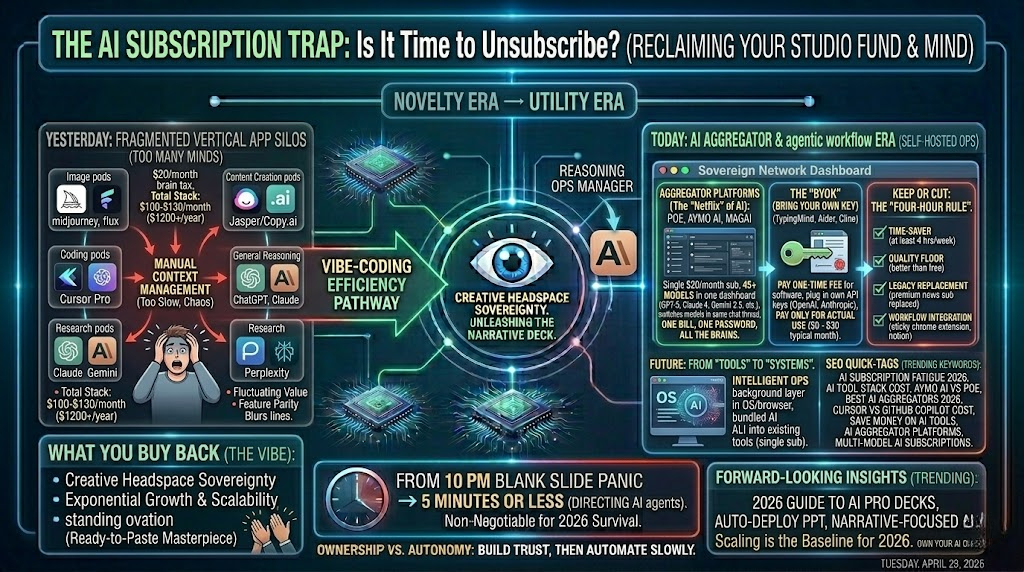
The AI Subscription Trap: Is it Time to Unsubscribe? (2026 Edition)
We’ve all been there: staring at a credit card statement and wondering when, exactly, our professional life became a collection of $20-a-month “micro-leaks.”
A few years ago, paying for an AI tool felt like buying a superpower. Today, it feels like managing a digital cable package from 1998—fragmented, expensive, and full of features you only use 10% of the time. According to recent 2026 consumer data, the average household now manages 11.2 active subscriptions, with nearly 47% of users canceling at least one service this year due to sheer cognitive overload.
Welcome to the era of AI Subscription Fatigue. If you feel like you’re spending more time comparing LLM leaderboards than actually getting work done, you aren’t alone. The market has moved from “novelty” to “utility,” and with that shift comes a hard truth: you probably don’t need five different AI brains.
The Math of the “Modern Stack”
Let’s look at what a “standard” professional AI stack looks like in April 2026. If you’re a creator, developer, or founder, your monthly “AI Tax” might look something like this:
| Tool | Purpose | Monthly Cost (Est.) |
| ChatGPT Plus | General Purpose / Voice | $20 |
| Claude Pro | Long Context / Nuanced Writing | $20 |
| Perplexity Pro | Search & Research | $20 |
| Cursor Pro | AI Coding Environment | $20 |
| Midjourney / Flux | Visual Content | $10 – $30 |
| Notion AI / Otter | Workflow & Meetings | $10 – $20 |
| Total | $100 – $130 / month |
That’s over $1,200 a year just to have the “best” tools for every specific task. For power users, the “Ultra” or “Max” tiers (like Cursor Ultra or Claude Code Max) have pushed those individual costs up to $200/month, making a high-end AI stack more expensive than a car payment.
Why It Feels So Fragmented
The problem isn’t that these tools aren’t useful; it’s that they are silos.
- Fragmented Context: You talk to Claude about your brand strategy, but then you have to manually copy that context into Midjourney to get the right images.
- Fluctuating Value: You might use Cursor for 40 hours one week during a sprint and then not touch it for a month. Yet, the $20-40 charge remains.
- Feature Parity: ChatGPT now has “Search,” Perplexity now has “Pages,” and Claude now has “Artifacts.” The lines are blurring, making it harder to justify keeping all three.
“We aren’t choosing an assistant anymore; we’re managing an IT department for a team of one.”
The 2026 Solution: Aggregators and “BYOK”
If you’re feeling the fatigue, the market has finally caught up with a solution. 2026 is officially the Year of the Aggregator. Instead of paying five different companies, smart users are moving toward two specific models:
1. AI Aggregator Platforms (The “Netflix” of AI)
Platforms like Aymo AI, Poe, and MagAI have become the primary defense against subscription fatigue.
- The Deal: For a single $20/month subscription, you get access to 45+ models (GPT-5, Claude 4, Gemini 2.5, DeepSeek, etc.) in one dashboard.
- The Benefit: You can switch from “Researching with Perplexity” to “Writing with Claude” in the same chat thread. One bill, one password, all the brains.
2. The “BYOK” (Bring Your Own Key) Model
For the more tech-savvy, tools like TypingMind, Aider, and Cline are surging in popularity.
- The Deal: You pay a one-time fee for the software and then plug in your own API keys from OpenAI or Anthropic.
- The Benefit: You only pay for what you actually use. If you don’t use AI for a month, your bill is $0. If you have a heavy week, you might spend $30. It puts the control back in your hands.
The “Keep or Cut” Framework
How do you decide which subscriptions to kill? I use the “Four-Hour Rule.” If a tool doesn’t meet at least one of these criteria, it gets moved to the “Free Tier” or canceled immediately:
- The Time-Saver: Does it save me at least 4 hours of manual labor per week? (e.g., Cursor for devs, Fireflies for managers).
- The Quality Floor: Does it produce a result that is obviously better than the free versions of its competitors?
- The Legacy Replacement: Has it replaced a non-AI tool I used to pay for? (e.g., Using Perplexity instead of a premium news sub).
- Workflow Integration: Is it “sticky”? Does it live where I already work (like a Chrome extension or a Notion integration), or do I have to remember to go to its website?
The Future: From “Tools” to “Systems”
As we look toward the rest of 2026, the trend is moving away from “vertical” apps (one app for one task) and toward holistic layers. We are seeing the rise of “Intelligent Ops,” where AI is a background layer in your OS or your browser rather than a destination.
Microsoft, Google, and Apple are all fighting to be your “Single Subscription” by bundling AI into the tools you already pay for. The “standalone” AI app is becoming a harder sell unless it offers something truly specialized.
Final Thoughts
Subscription fatigue is a sign of a maturing market. The “Gold Rush” phase where we signed up for everything is over. Now, we’re in the “Efficiency” phase. It’s okay to let a subscription go. Most of these tools have a “Pause” feature now—use it.
The best AI stack isn’t the one with the most models; it’s the one that you actually use without thinking about the price tag every time you hit “Enter.”
Do you currently use a single “All-in-One” aggregator like Poe or Aymo, or do you still prefer having direct, separate subscriptions for the ‘Big Three’ (OpenAI, Anthropic, Google)?
Stay Connected
Blogs WhatsApp Channel (for daily quizzes and blog updates):
https://whatsapp.com/channel/0029VbCcWME4inotCWmN5511
Telegram Channel (Job Updates & Career Alerts):
https://t.me/careervalore
WhatsApp Channel (Daily Job Updates):
https://www.whatsapp.com/channel/0029Vay7sUV11ulUIhLBUI44
Leave a Reply